 I’m working on establishing a separate Indie Pub website, but it’s not ready for prime time, yet. So, for now, I’m just going to borrow the site I use for my memoir writing classes. Hope you don’t mind.
And so, without dithering further, here is:
A Brief History of Independent Publishing
There are basically two formats for publishing one’s work these days: ink on paper and digital. Anyone can assemble pages–done by hand like Dark Age monks, cranked through a mimeograph machine, or printed on the $99 printer in your basement. Staple them together and you have a book.
A slightly more elegant product can be assembled at the local office supply store. But the latest innovation for do-it-yourself publishers is “print on demand” or POD books. Digital books are cheaper and easier to produce, but much of the process is the same as for POD books.
Nowadays, the biggest obstacle to independent publishing is creating something worth printing. Anyone who’s spent time browsing Amazon for new books has seen examples of both good and bad work. In fact, much of the reading public still thinks that an indie imprint automatically means poor quality. The Big Six publishers want everyone to think that, and indie publishers who fail to make their work look professional only add to the misconception.
Not long ago, the only way someone could self-publish a book was to use a so-called vanity press. These outfits would accept anything from anyone, and for the right price, usually $2,000 to $5,000, would print several hundred hardback copies and ship them to the author’s address. These usually filled up basements, garages and storage sheds until someone grew weary and had them hauled off to a landfill.
There were virtually no markets outside of what the author could peddle from the trunk of a car. That has changed. Drastically. The biggest problem with self-published work–then AND now–is that many indie authors put in too little time and energy to create something that looks and reads like the product of a big name publisher. Because indies don’t have, or can’t afford, editors, copy-editors, graphic designers and marketers, their books often look homemade.
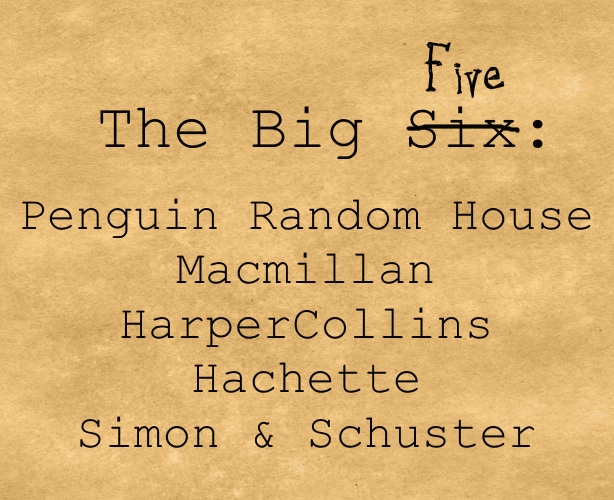
With effort, however, indie books can look and read just as good as anything from Simon and Schuster, HarperCollins, Random House, Macmillan, The Penguin Group, or Hachette. (Only two of The Big Six are US companies, by the way: Simon and Schuster, and HarperCollins. Of the others, two are German, one is British, and one is French.)
Simon and Schuster was established in 1924 in New York City by Richard Simon and Max Schuster. It was one of many stand-alone publishing houses. CBS Corporation now owns the name and publishes over two thousand titles a year. Those books appear under 35 different “imprints” which most people believe are separate and independent publishing companies. They aren’t. At least, not anymore.
HarperCollins isn’t just the outcome of two merged publishers. Harper was founded in New York City almost 200 years ago by James and John Harper, brothers. The company prospered and in 1962 merged with Row, Peterson & Company, becoming Harper & Row Publishers, Inc. The new company acquired the publishing houses of Crowell, and Lippincott and Zondervan and Scott, Foresman. The consolidated Harper company was then bought by Rupert Murdoch’s conglomerate, News Corporation Limited. It later acquired a British publishing house, William Collins & Sons, which was founded in 1819. The distinguished old name Harper was conjoined to the equally distinguished old name Collins to make HarperCollins, a huge subsidiary of News Corp, the world’s largest media company.
 Pulp magazines evolved in the late 1800s and changed the way readers got their novels and stories. In the 1930s and 40s, mass market paperbacks changed the distribution of novels and stories to readers again. Electronic books are merely the most recent iteration of the cycle starting around 2009. Over and over, a new way to distribute reading material supplants the old method. Each time, pricey books find a less-expensive way into the hands of readers. It started with Johannes Gutenberg whose printing press put countless transcriptionists out of work in the 1400s. Pulps revamped the system in 1895, and paperbacks did it in 1950. Now, sixty-five years later, it’s happening again.
Amazon, like it or not, owns very little of the market compared to the old American News Company. It controlled virtually all the magazines, comics, and most book distribution in America in the first half of the 20th century. Then, in 1957, it went broke.
In 1940, about half of all novels published were only published in the pulps. At the height of the mass market paperbacks, around 2005, about half of all novels published were only published as mass market paperbacks. It’s a safe bet that will be the number for electronic novels in a decade or so.
Independent publishing is hardly new. Writers published their own books for a long time before the vanity press entered the picture in the 1950s. Before then, publishing your own work or starting your own press was widely accepted. The number of self-published authors was legion. It will be a vastly greater number very soon.
If you look at the books published a hundred years ago, you’ll see almost no sign of today’s publishers. Those you think of as huge now were small press or solo shops–indie presses–50 or 100 years ago. The indies grew up to replace the old, slow legacy publishers of that day. And that’s what is happening now.
–Josh
PS: This was written in 2014. Since then the Big Six have become the Big Five.
 ELM Advanced Fiction Class